
Choose the right management system and you’ll find out!
Everyone likes to believe that they are competent to deliver effectively and efficiently in their role at work. Simply learning about a task, or completing training for it, does not in itself confirm that a person can perform that task consistently, safely, and to the required standard in real-world conditions. At best, it demonstrates potential rather than proven competence.
For most organisations, however, knowing that an employee has the potential to do a task is not enough. Organisations have to actually know whether an employee can perform a task when called upon.
This is increasingly driven by regulatory scrutiny, operational risk, and the expectation that organisations can evidence competence at the point of work, not just at the point of training.
This is especially important when safety and compliance are part of daily operations. With the Health and Safety Executive (HSE) issuing over 4,400 notices in 2024/25, including 3,200 improvement notices and 1200 notices prohibiting work actively placing people at risk of death or serious injury , it is easy to see why.
So how can companies keep on top of learning, training and competence in their workforce to know they have competent employees ready and waiting to do a job?
Understanding your needs
Most organisations know that legacy systems for tracking staff training, learning and competency are no longer fit for purpose, especially as technology advances along with regulation and compliance. Paper-stuffed filing cabinets and over-complicated spreadsheets no longer cut it.
Moving forward then, getting to know the difference between a Training, Learning and Competency Management System will help companies choose what they need from their new system.
Training Management System (TMS)
Think of a TMS as a basic, entry level system. It is more a diary or tick-box record of attendance on a training course, focussing on scheduling attendance. Unfortunately, this system may not necessarily translate into increased capability of employees.
While a TMS can provide useful visibility of attendance and scheduling, on its own it offers limited insight into whether learning has translated into on-the-job capability.
Learning Management System (LMS)
Learning Management Systems (LMS) focus on the delivery, management, and tracking of learning interventions. Modern LMS platforms can support a wide range of content types, assessment methods, and learning journeys, and play a critical role in developing knowledge and supporting compliance. Watch out though, many organisations tend to refer to all L&D systems as a learning management system (LMS) but that might not be the case. Those looking for a new L&D system must be clear about their requirements and ensure they’re using the correct terminology when searching for a solution.
However, even sophisticated LMS platforms are typically structured around learning activity and completion, rather than the ongoing assurance of role-specific competence in live operational environments.
Competency Management System (CMS)
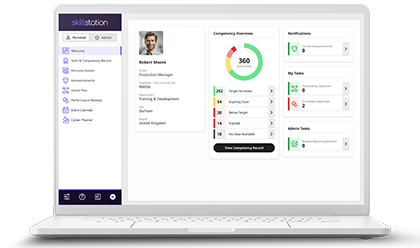
A Competency Management System (CMS) is designed around capability and readiness rather than course completion. Its primary purpose is to evidence that individuals can perform specific tasks safely and effectively, to a defined standard, and over time, not just immediately after training.
These include:
- Training – Face-to-face, internal and external, on the job, mentoring etc
- Assessments – All assessments are combined and weighted to provide evidence of knowledge
- Knowledge – the ability to assess the acquisition of knowledge through a range of assessments including multiple-choice assessments, short answer free text Q&A, projects etc.
- eLearning – some CMS platforms also support and incorporate a learning management system (LMS) module too.
- Competence – the ability to demonstrate that the required level of proficiency (competence) has been achieved in a robust and rigorous way including the supporting evidence to support this.
- Culture – the ability to define assess alignment with an organisation’s human factors such as values and behaviours.
- Reporting – the ability report across all your L&D activity to identify, develop and manage your talent.
Together, these elements allow organisations to move from tracking learning activity to evidencing real-world competence, supporting assurance, audit readiness, and operational decision-making.
The last point is vital. Without reporting there could be vital pieces of the competency puzzle missing, leaving organisations short-staffed at a critical time. A well-designed CMS enables organisations to understand capability, risk exposure, and readiness across roles, teams, and functions whilst also supporting workforce planning, succession decisions, and proactive risk management.
Do the legwork before choosing a new system
As an online platform provider, Think Eleven knows how difficult it can be to select the right system. That’s why a Functional Requirement Specification (FRS) is a great tool to use, enabling organisations to compare features between an LMS, TMS and CMS. An FRS helps organisations move beyond marketing language and compare systems based on how well they support their operating model, risk profile, and competency assurance requirements.
An LMS typically specialises in the delivery of eLearning and a TMS focuses on planning and recording training. A good CMS however, can deliver both LMS and TMS capability in addition to providing the structured evidence of competence, on-the-job assessment, and assurance required for organisations to demonstrate workforce capability and compliance confidently. This is vital for an employer to understand the true competency of their workforce, particularly in regulated or safety-critical environments. A good CMS should become your single source of truth to demonstrate and evidence competence and capability across your entire workforce.
Find out more about SkillStation, the secure online Competency Management System (CMS) from Think Eleven here