Skillstation research / 2026
Are UK businesses mistaking compliance for competence?
Published Last updated
Key findings
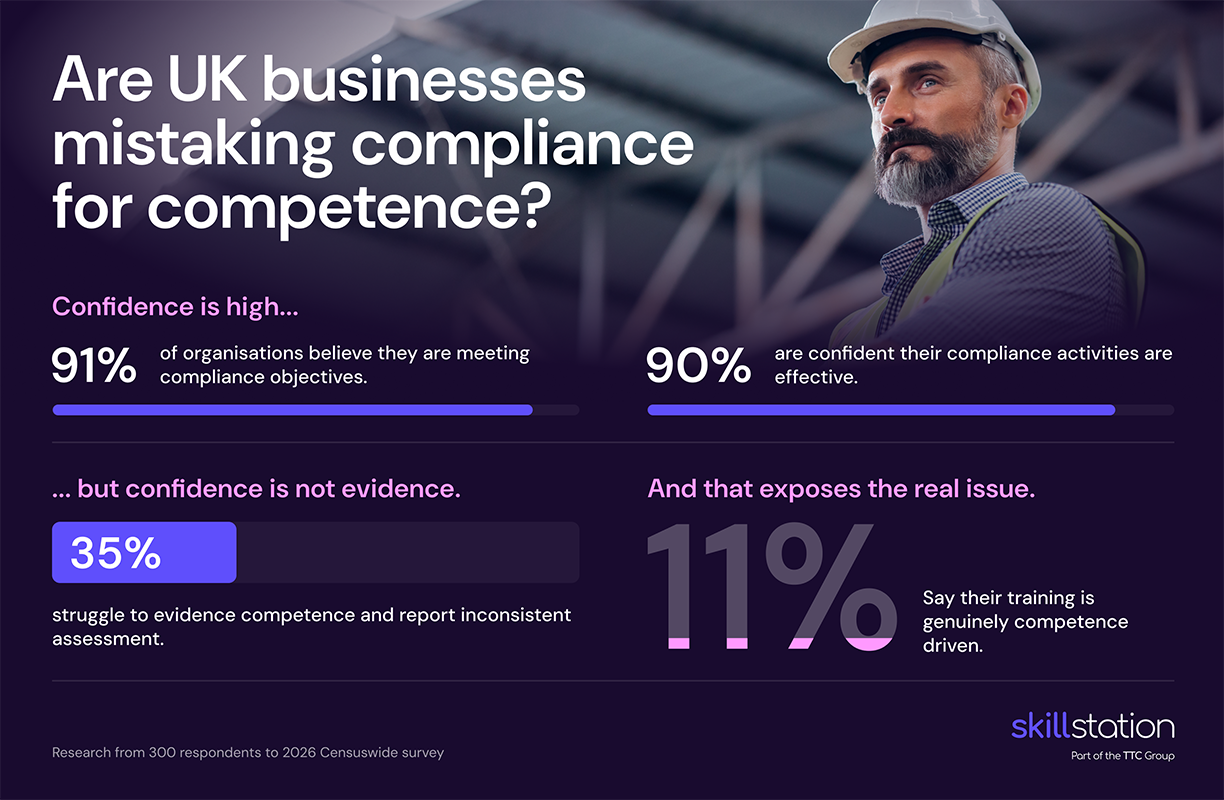
- 91% of organisations believe they are meeting compliance objectives.
- 90% are confident their compliance activities are effective.
- 98% believe compliance results in competence.
- 35% struggle to evidence competence and report inconsistent assessment.
- Only 11% say their training approach is genuinely competence-driven.
Introduction
UK organisations have never been more confident about compliance. New research from SkillStation, part of the TTC Group, suggests that confidence is not matched by evidence of competence. SkillStation's 2026 survey of 300 UK senior decision makers, conducted by Censuswide, examined how organisations in construction, architecture, manufacturing, health and fleet manage compliance and competence. It found that 91% believe they are meeting their compliance objectives, yet only 11% say their training approach is genuinely competence-driven, and a third of employees still require additional training.
The full research results
| Finding | Figure |
|---|---|
| Believe they are meeting compliance objectives | 91% |
| Are confident their compliance activities are effective | 90% |
| Say they assess competence | 65% |
| Struggle to evidence competence and report inconsistent assessment | 35% |
| Believe compliance results in competence | 98% |
| Say their training approach is driven primarily by compliance | 37% |
| Say their training approach is genuinely competence-driven | 11% |
| Of employees still require additional training | 33% |
What the research found
Regulatory expectations are at an all-time high, and rightly so: employers face increasing scrutiny around health, safety and duty of care, especially in safety-critical industries where poor compliance and competence management can have serious consequences. Against that backdrop, confidence is strong. 91% of the senior decision makers surveyed believe their organisation is meeting its compliance objectives, and 90% are confident their compliance activities are effective. 65% say they assess competence.
The evidence tells a different story. Despite that confidence, 33% of employees still require additional training, and 35% of organisations admit they find it difficult to evidence competence and report inconsistencies in assessment across employees. Confidence in compliance is high; proof of competence is much thinner.
Why compliance does not guarantee competence
The gap appears to be structural. 98% of organisations believe that compliance results in competence, a misconception between compliance, which may provide legal protection, and real-world performance. Training approaches reinforce it: 37% of senior decision makers say their programmes are driven primarily by compliance, while only 11% say their training approach is genuinely competence-driven.
“Our research shows that UK businesses are incredibly confident in their compliance procedures. Workplace competence, however, is telling a different story as a third of employees have training outstanding or unassessed competence. Unless this gap is bridged and mechanisms put in place to check that training has been successful, this misplaced confidence could prove damaging. Afterall, compliance training sets the standards of knowledge and skills required in your staff, while competence checking ensures that those standards are being demonstrated in everyday practice.”
SkillStation
What this means for UK employers
The pressure is set to grow. Skills England's first annual skills report found that demand for skills in priority sectors including digital, construction and transportation will grow by 24% over the next decade. Stretched employers will be tempted to give people tasks they are not yet competent in, at the same time as regulators and professional bodies increasingly expect employers to demonstrate that employees have the right knowledge, skills and behaviours to perform their role safely and effectively (Source - Developing an Occupational Standard). Attendance at a training session is no longer sufficient evidence of competence.
What organisations can do
Closing the competence gap means proving that people are capable, not simply trained. In practice that requires four things: a defined competency framework for each role; consistent assessment against it, rather than assessment that varies by manager; evidence, so that competence can be demonstrated to a regulator or auditor rather than asserted; and real-time visibility of gaps, so they are addressed before they become risks.
Competency management systems such as SkillStation provide that structure, bringing training records, assessments and evidence together into one auditable view of workforce capability. For organisations starting from spreadsheets, our skills matrix guide explains the foundations.
Methodology
The research was conducted by Censuswide on behalf of SkillStation in [month] 2026, among 300 senior decision makers in human resources, procurement and general management, across the construction, architecture, manufacturing, health and fleet sectors. Percentages are rounded.
About SkillStation
SkillStation, part of the TTC Group, is a leading all-in-one competency management platform designed to help organisations take control of workforce skills, training, and compliance. Used by organisations across multiple sectors and deployed internationally, SkillStation provides the structure to define competency frameworks, bringing together training records, assessments, and evidence into one centralised system. It delivers a real-time, auditable view of workforce competence and capability.
Embed this article
<a href="https://www.thinkeleven.co.uk/research/compliance-vs-competence-2026">
  <img src="https://www.thinkeleven.co.uk/images/skillstation-compliance-vs-competence-research-2026.png"
       alt="SkillStation 2026 research: are UK businesses mistaking compliance for competence?"
       width="600">
</a>
<p>Infographic by <a href="https://www.thinkeleven.co.uk/research/compliance-vs-competence-2026">SkillStation</a></p>